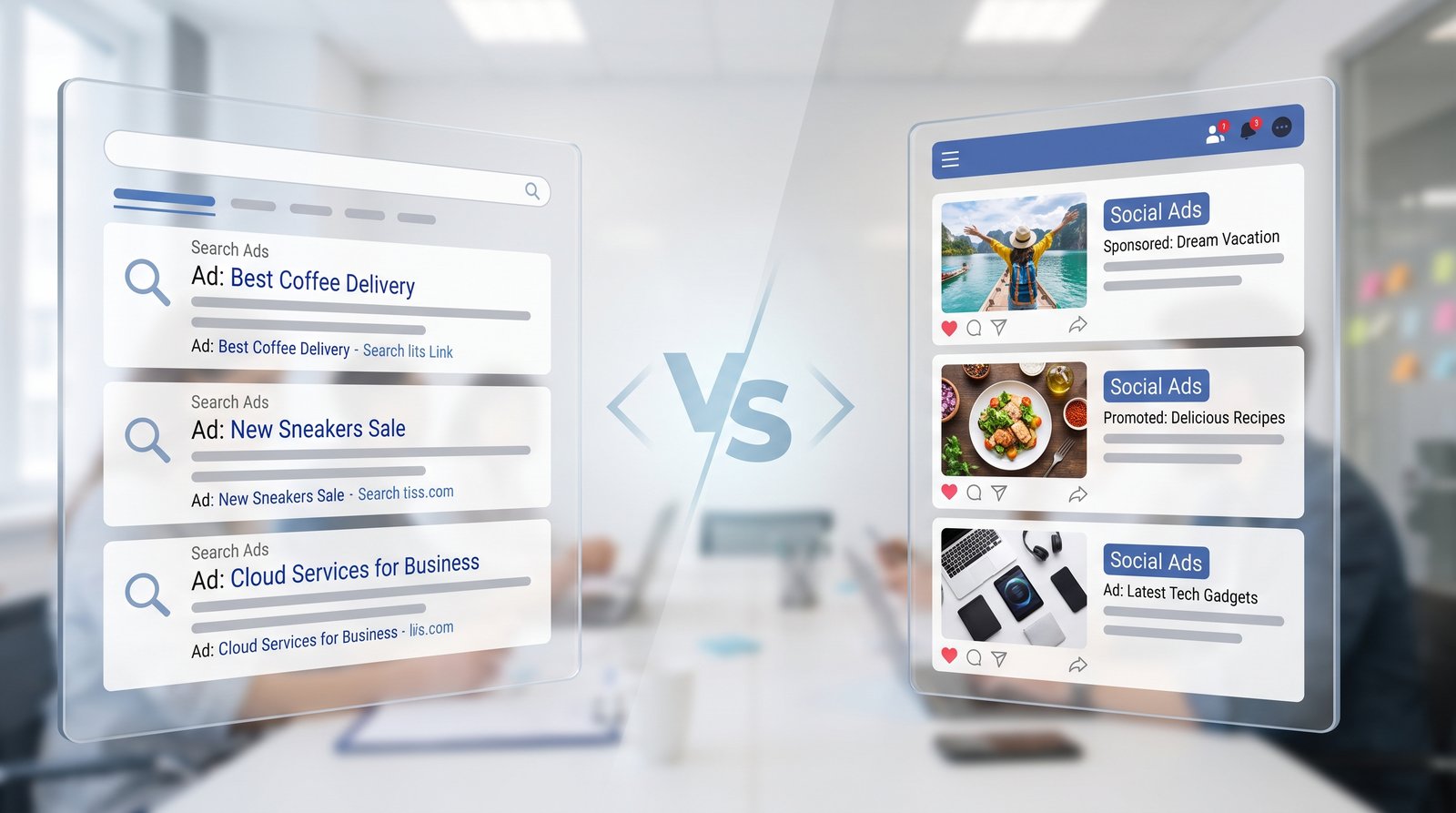
Google Ads vs Facebook Ads: which should you try first?
Quick answerTry Google Ads first if customers already search for exactly what you sell. Try Facebook or Instagram first if you sell something people discover rather than search for. Most local businesses can benefit from both eventually, but starting with one lets you learn what's actually working.
Every small business owner eventually asks this question: Google or Facebook? It feels like it should have a simple answer, but the honest one is that the two work in completely different ways, and knowing which is which can save you a lot of wasted spend.
Here's the plain version, without the jargon that usually clouds this decision, so you can figure out which ad platform actually makes sense to try first.
Google reaches people already looking for you
Google Ads shows up when someone types in a search: "plumber near me," "custom cakes Tulsa," "roof repair OKC." That person already has a need. They're not being introduced to your business, they're actively hunting for it. This is what's sometimes called demand capture: the demand already exists out there, and your ad just makes sure your business is the one they find first.
That's why Google Ads tends to work well for businesses with a clear, searchable service. If people already type a phrase into Google when they need what you sell, Google puts you in front of them at the exact moment they're ready to act, which is a genuinely useful place to be.
Facebook and Instagram put you in front of people who aren't searching yet
Facebook and Instagram ads work differently. Nobody is searching "custom cakes" while scrolling their feed. Instead, you're showing your business to people who fit your customer profile: their age, their location, their interests, their behavior online, even though they weren't actively looking for you in that moment. This is demand creation. You're introducing yourself to someone who might want what you offer, before they ever thought to go looking for it.
This tends to matter most for businesses that sell something people don't search for by name, or something visual enough to stop a scroll: a boutique's new arrivals, a restaurant's seasonal menu, a remodeling job's before-and-after, a service people don't yet realize is available locally.
Matching the platform to your budget when you're just starting out
If your budget is tight, this difference has real consequences. Google Ads charges you per click, and for competitive local terms those clicks can add up fast, especially in categories like home services or legal work where a lot of businesses are bidding on the same handful of searches. You can still start small, but you'll want to watch your cost per lead closely from day one.
Facebook and Instagram usually let you stretch a modest budget further, because you're not competing for a scarce set of high-intent searches. The tradeoff is that the people seeing your ad are colder: they need to be convinced, not just captured. That usually means your offer and your creative have to do more of the work.
Neither platform is the "cheap" one or the "expensive" one in any fixed sense. It depends on your industry, your competition, and what you're asking people to do.
How to tell which one your business needs first
Ask yourself one question: does a customer with your exact problem already know to search for it? If someone with a leaky faucet, a toothache, or a broken air conditioner knows exactly what to type into Google, that's a strong signal to start there. The demand already exists. Your job is just to be visible when it shows up.
If your business is more of a discovery: a new spot people stumble onto, a product people didn't know they wanted, a service that solves a problem they hadn't quite named yet, Facebook and Instagram are built for introducing yourself to the right audience before they start searching.
Most local businesses actually have some of both. A dentist gets searched by name and by symptom, but also benefits from being seen by people who haven't thought about their smile in years. The point of starting with one platform isn't that the other is wrong. It's that testing one thing at a time is how you learn what's actually working, instead of guessing at which platform gets credit.
If your ads on either platform are already running and not producing much, it's worth reading through why your ads aren't working before you add a second platform on top of a first one that isn't yet earning its keep.
The honest part
Both platforms can work. Neither works by accident, and neither works overnight. Google Ads rewards a business that's ready to compete for clicks and convert them once they land. Facebook and Instagram reward a business with a clear offer and creative worth stopping for. Running either one well takes ongoing attention: watching what's spending, what's converting, and adjusting as you go, week after week.
Most owners don't have the time to babysit an ad account on top of running the actual business, which is exactly the kind of thing we handle. If you're not sure which platform fits your business, tell us about your ad campaigns and we'll help you figure out where to start, with a clear quote for what it would take to run it well.
Frequently asked questions
Can I run Google Ads and Facebook Ads at the same time?
You can, but it's usually smarter to start with one and get it working before adding the other. Running both at once with a small budget makes it hard to tell which platform is actually earning its keep.
Which platform is cheaper for a small business?
Neither is cheaper in a fixed sense. Google Ads charges per click and competitive local terms can cost more, while Facebook and Instagram often stretch a small budget further but need stronger creative to convert cold viewers.
How do I know if people are already searching for my business?
Ask yourself whether a customer with your exact problem would know what to type into Google. If the answer is yes, that's a sign Google Ads is worth trying first.